Class managing buffer resources. More...
#include <buffer_resource.hpp>
Public Member Functions | |
| BufferResource (BufferResource const &)=delete | |
BufferResource is non-copyable, it is owned by std::shared_ptr. | |
| BufferResource (BufferResource &&)=delete | |
BufferResource is non-movable, it is owned by std::shared_ptr. | |
| BufferResource & | operator= (BufferResource const &)=delete |
BufferResource is non-copyable. More... | |
| BufferResource & | operator= (BufferResource &&)=delete |
BufferResource is non-movable. More... | |
| rmm::device_async_resource_ref | device_mr () noexcept |
| Get the device memory resource. More... | |
| RmmResourceAdaptor & | device_mr_adaptor () noexcept |
| Access the concrete device memory resource adaptor. More... | |
| rmm::host_async_resource_ref | host_mr () noexcept |
| Get the RMM host memory resource. More... | |
| rmm::host_device_async_resource_ref | pinned_mr () |
| Get the RMM pinned host memory resource. More... | |
| std::optional< PinnedMemoryResource > | try_pinned_mr () const |
| Get the pinned host memory resource if available. More... | |
| std::int64_t | memory_available (MemoryType mem_type) const noexcept |
| Returns the currently available memory for a given memory type, in bytes. More... | |
| void | set_memory_limit (MemoryType mem_type, std::int64_t limit) noexcept |
| Updates the memory limit for a given memory type at runtime. More... | |
| std::size_t | memory_reserved (MemoryType mem_type) const |
| Get the current reserved memory of the specified memory type. More... | |
| std::pair< MemoryReservation, std::size_t > | reserve (MemoryType mem_type, std::size_t size, AllowOverbooking allow_overbooking) |
| Reserve an amount of the specified memory type. More... | |
| MemoryReservation | reserve_device_memory_and_spill (std::size_t size, AllowOverbooking allow_overbooking) |
| Reserve device memory and spill if necessary. More... | |
| template<std::ranges::input_range Range> | |
| requires std::convertible_to< std::ranges::range_value_t< Range >, MemoryType > MemoryReservation | reserve_or_fail (std::size_t size, Range mem_types) |
| Make a memory reservation or fail based on the given order of memory types. More... | |
| MemoryReservation | reserve_or_fail (std::size_t size, MemoryType mem_type) |
| Make a memory reservation or fail. More... | |
| std::size_t | release (MemoryReservation &reservation, std::size_t size) |
| Consume a portion of the reserved memory. More... | |
| std::unique_ptr< Buffer > | make_buffer (std::size_t size, rmm::cuda_stream_view stream, MemoryReservation &reservation) |
| Allocate a buffer of the specified memory type by the reservation. More... | |
| std::unique_ptr< Buffer > | make_buffer (rmm::cuda_stream_view stream, MemoryReservation &&reservation) |
| Allocate a buffer consuming the entire reservation. More... | |
| std::unique_ptr< Buffer > | move (std::unique_ptr< rmm::device_buffer > data, rmm::cuda_stream_view stream) |
| Move device or pinned host buffer data into a Buffer. More... | |
| std::unique_ptr< Buffer > | move (std::unique_ptr< Buffer > buffer, MemoryReservation &reservation) |
| Move a Buffer to the memory type specified by the reservation. More... | |
| std::unique_ptr< rmm::device_buffer > | move_to_device_buffer (std::unique_ptr< Buffer > buffer, MemoryReservation &reservation) |
| Move a Buffer to a device buffer. More... | |
| std::unique_ptr< HostBuffer > | move_to_host_buffer (std::unique_ptr< Buffer > buffer, MemoryReservation &reservation) |
| Move a Buffer into a host buffer. More... | |
| std::shared_ptr< rmm::cuda_stream_pool > const & | stream_pool () const |
| Returns the CUDA stream pool used by this buffer resource. More... | |
| SpillManager & | spill_manager () |
| Gets a reference to the spill manager used. More... | |
| std::shared_ptr< Statistics > | statistics () const noexcept |
| Gets a shared pointer to the statistics associated with this buffer resource. More... | |
Static Public Member Functions | |
| static std::shared_ptr< BufferResource > | create (cuda::mr::any_resource< cuda::mr::device_accessible > device_mr, std::optional< PinnedPoolProperties > pinned_pool_properties=PinnedMemoryDisabled, std::unordered_map< MemoryType, std::int64_t > memory_limits={}, std::optional< Duration > periodic_spill_check=std::chrono::milliseconds{1}, std::shared_ptr< rmm::cuda_stream_pool > stream_pool=std::make_shared< rmm::cuda_stream_pool >(16, rmm::cuda_stream::flags::non_blocking), std::shared_ptr< Statistics > statistics=Statistics::disabled()) |
Construct a BufferResource managed by std::shared_ptr. More... | |
| static std::shared_ptr< BufferResource > | from_options (cuda::mr::any_resource< cuda::mr::device_accessible > mr, config::Options options, std::shared_ptr< Statistics > statistics=Statistics::disabled()) |
| Construct a BufferResource from configuration options. More... | |
Detailed Description
Class managing buffer resources.
This class handles memory allocation and transfers between different memory types (e.g., host and device). All memory operations in rapidsmpf, such as those performed by the Shuffler, rely on a buffer resource for memory management.
- Note
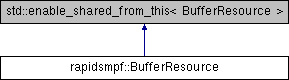
BufferResourceinstances must be constructed throughcreate()orfrom_options(), both of which return astd::shared_ptr<BufferResource>. Direct construction is disabled.-
Allocation tracking only applies to allocations routed through this
BufferResource. The constructor wraps the supplied device memory resource in an internal adaptor that records all allocations and deallocations; that adaptor is exposed viadevice_mr().
Allocations made through the original, unwrapped memory resource bypass this tracking and are therefore invisible to memory-limit accounting and statistics.
To ensure all CUDA allocations count against the BufferResource budget, use br->device_mr() everywhere instead of the underlying memory resource passed to the constructor.
Tracking allocations made outside BufferResource, for example allocations performed before construction or through code paths that use a raw memory resource directly, is a separate design concern and is not handled by this class.
Definition at line 76 of file buffer_resource.hpp.
Member Function Documentation
◆ create()
|
static |
Construct a BufferResource managed by std::shared_ptr.
Available memory is computed per MemoryType as limit - allocated.
Device and pinned-host allocations routed through this BufferResource are tracked automatically. Host memory allocations are not tracked and therefore always report the configured limit as available memory.
If pinned-host memory is disabled, available pinned-host memory is always reported as zero regardless of the configured limit.
- Parameters
-
device_mr Device memory resource used for device allocations. To ensure allocations are tracked for memory-limit accounting and statistics, use BufferResource::device_mr()instead of the original memory resource after construction.pinned_pool_properties Configuration for the pinned host memory pool used for MemoryType::PINNED_HOSTallocations, orPinnedMemoryDisabledto disable pinned allocations. The pinned resource is constructed internally and owned by theBufferResource. When a value is provided, pinned host memory must be supported on the system (seeis_pinned_memory_resources_supported()); otherwise astd::runtime_erroris thrown.memory_limits Maximum allocation limits in bytes per MemoryType. Missing entries are treated as unlimited.periodic_spill_check Interval between periodic spill checks. std::nulloptdisables the dedicated spill-check thread.stream_pool CUDA stream pool used for operations that do not take an explicit CUDA stream. statistics Statistics instance used for runtime metrics.
- Returns
- A newly constructed
BufferResourceowned bystd::shared_ptr.
- Exceptions
-
std::runtime_error if pinned_pool_propertieshas a value but pinned host memory is not supported on this system.
◆ device_mr()
|
noexcept |
Get the device memory resource.
- Returns
rmm::device_async_resource_refto the device memory resource.
- CCCL's lifetime semantic
The returned rmm::device_async_resource_ref is a non-owning cuda::mr::resource_ref, so callers must take care to avoid use-after-free issues.
When working directly with the returned reference, the caller must ensure that this BufferResource remains alive for the full duration of that use:
To store the resource beyond the immediate call, promote the ref to an owning cuda::mr::any_resource:
In the common case, no explicit promotion is needed because RMM containers that store a memory resource do this internally:
- Note
- Device memory resource provided to the constructor is wrapped in an
RmmResourceAdaptorfor allocation tracking, and concretely the returned resource_ref points to that adaptor. Seedevice_mr_adaptor()for a more convenient way to access the adaptor.
◆ device_mr_adaptor()
|
noexcept |
Access the concrete device memory resource adaptor.
BufferResource wraps the device memory resource in an internal RmmResourceAdaptor for allocation tracking. This exposes that adaptor directly, e.g. to query allocation statistics via get_main_record() or current_allocated().
- Returns
- Reference to the internal device
RmmResourceAdaptor. The reference is valid for as long as thisBufferResourceis alive.
- Note
- To ensure that the allocations are properly tracked, use
device_mr()ordevice_mr_adaptor()instead of the original memory resource passed to the constructor.
◆ from_options()
|
static |
Construct a BufferResource from configuration options.
This factory method creates a BufferResource using configuration options to initialize all components. The supplied device memory resource is wrapped in an internal RmmResourceAdaptor for allocation tracking.
- Parameters
-
mr A device-accessible RMM memory resource. options Configuration options. statistics The statistics instance to use (disabled by default).
- Returns
- A shared pointer to a BufferResource instance configured according to the options.
◆ host_mr()
|
noexcept |
Get the RMM host memory resource.
- Returns
- Reference to the RMM resource used for host allocations.
- Note
- Lifetime semantics are identical to
device_mr(). See its@par CCCL lifetime semanticssection for details. In brief, the returnedresource_refis non-owning. Promote it to aany_host_resourceto extend theBufferResourcelifetime.
◆ make_buffer() [1/2]
| std::unique_ptr<Buffer> rapidsmpf::BufferResource::make_buffer | ( | rmm::cuda_stream_view | stream, |
| MemoryReservation && | reservation | ||
| ) |
Allocate a buffer consuming the entire reservation.
This overload allocates a buffer that matches the full size and memory type of the provided reservation. The reservation is consumed by the call.
- Parameters
-
stream CUDA stream to use for device allocations. reservation The memory reservation to consume for the allocation.
- Returns
- A unique pointer to the allocated Buffer.
◆ make_buffer() [2/2]
| std::unique_ptr<Buffer> rapidsmpf::BufferResource::make_buffer | ( | std::size_t | size, |
| rmm::cuda_stream_view | stream, | ||
| MemoryReservation & | reservation | ||
| ) |
Allocate a buffer of the specified memory type by the reservation.
- Parameters
-
size The size of the buffer in bytes. stream CUDA stream to use for device allocations. reservation The reservation to use for memory allocations.
- Returns
- A unique pointer to the allocated Buffer.
- Exceptions
-
std::invalid_argument if the memory type does not match the reservation. rapidsmpf::reservation_error if sizeexceeds the size of the reservation.
◆ memory_available()
|
noexcept |
Returns the currently available memory for a given memory type, in bytes.
Computed as limit - allocated, where allocated is reported by the memory type's allocation counter (see the constructor documentation for how each memory type is tracked). The value may be negative when allocations exceed the configured limit.
- Parameters
-
mem_type The memory type to query.
- Returns
- The available memory in bytes.
◆ memory_reserved()
|
inline |
Get the current reserved memory of the specified memory type.
- Parameters
-
mem_type The target memory type.
- Returns
- The memory reserved.
Definition at line 290 of file buffer_resource.hpp.
◆ move() [1/2]
| std::unique_ptr<Buffer> rapidsmpf::BufferResource::move | ( | std::unique_ptr< Buffer > | buffer, |
| MemoryReservation & | reservation | ||
| ) |
Move a Buffer to the memory type specified by the reservation.
If the Buffer already resides in the target memory type, a cheap move is performed. Otherwise, the Buffer is copied to the target memory using its own CUDA stream.
- Parameters
-
buffer Buffer to move. reservation Memory reservation used if a copy is required.
- Returns
- Unique pointer to the resulting Buffer.
- Exceptions
-
rapidsmpf::reservation_error If the allocation size exceeds the reservation.
◆ move() [2/2]
| std::unique_ptr<Buffer> rapidsmpf::BufferResource::move | ( | std::unique_ptr< rmm::device_buffer > | data, |
| rmm::cuda_stream_view | stream | ||
| ) |
Move device or pinned host buffer data into a Buffer.
This operation is cheap; no copy is performed.
The resulting Buffer's memory type is inferred from data's memory resource: if the resource is host-accessible (e.g. pinned host memory), the Buffer is created with MemoryType::PINNED_HOST; otherwise it is created with MemoryType::DEVICE.
If stream differs from the device buffer's current stream:
streamis synchronized with the device buffer's current stream, and- the device buffer's current stream is updated to
stream.
- Parameters
-
data Unique pointer to the device or pinned host buffer. stream CUDA stream associated with the new Buffer. Use or synchronize with this stream when operating on the Buffer.
- Returns
- Unique pointer to the resulting Buffer.
◆ move_to_device_buffer()
| std::unique_ptr<rmm::device_buffer> rapidsmpf::BufferResource::move_to_device_buffer | ( | std::unique_ptr< Buffer > | buffer, |
| MemoryReservation & | reservation | ||
| ) |
Move a Buffer to a device buffer.
If the Buffer already resides in device memory, a cheap move is performed. Otherwise, the Buffer is copied to device memory using its own CUDA stream.
- Parameters
-
buffer The buffer to move. reservation Memory reservation used if a copy is required.
- Returns
- A unique pointer to the resulting device buffer.
- Exceptions
-
std::invalid_argument If the reservation's memory type isn't device memory. rapidsmpf::reservation_error if the memory requirement exceeds the reservation.
◆ move_to_host_buffer()
| std::unique_ptr<HostBuffer> rapidsmpf::BufferResource::move_to_host_buffer | ( | std::unique_ptr< Buffer > | buffer, |
| MemoryReservation & | reservation | ||
| ) |
Move a Buffer into a host buffer.
If the Buffer already resides in host memory, a cheap move is performed. Otherwise, the Buffer is copied to host memory using its own CUDA stream.
- Parameters
-
buffer Buffer to move. reservation Memory reservation used if a copy is required.
- Returns
- Unique pointer to the resulting host buffer.
- Exceptions
-
std::invalid_argument If the reservation's memory type isn't host memory. rapidsmpf::reservation_error If the allocation size exceeds the reservation.
◆ operator=() [1/2]
|
delete |
BufferResource is non-movable.
- Returns
- Reference to this.
◆ operator=() [2/2]
|
delete |
BufferResource is non-copyable.
- Returns
- Reference to this.
◆ pinned_mr()
| rmm::host_device_async_resource_ref rapidsmpf::BufferResource::pinned_mr | ( | ) |
Get the RMM pinned host memory resource.
- Exceptions
-
std::invalid_argument if no pinned memory resource is available.
- Returns
- Reference to the RMM resource used for pinned host allocations.
- Note
- Lifetime semantics are identical to
device_mr(). See its@par CCCL lifetime semanticssection for details. In brief, the returnedresource_refis non-owning. Promote it to aany_host_device_resourceto extend theBufferResourcelifetime.
◆ release()
| std::size_t rapidsmpf::BufferResource::release | ( | MemoryReservation & | reservation, |
| std::size_t | size | ||
| ) |
Consume a portion of the reserved memory.
Reduces the remaining size of the reserved memory by the specified amount.
- Parameters
-
reservation The reservation to release. size The size to consume in bytes.
- Returns
- The remaining size of the reserved memory after consumption.
- Exceptions
-
rapidsmpf::reservation_error if the released size exceeds the size of the reservation.
◆ reserve()
| std::pair<MemoryReservation, std::size_t> rapidsmpf::BufferResource::reserve | ( | MemoryType | mem_type, |
| std::size_t | size, | ||
| AllowOverbooking | allow_overbooking | ||
| ) |
Reserve an amount of the specified memory type.
Creates a new reservation of the specified size and type to inform about upcoming buffer allocations.
If overbooking is allowed, a reservation of size is returned even when the amount of memory isn't available. In this case, the caller must promise to free buffers corresponding to (at least) the amount of overbooking before using the reservation.
If overbooking isn't allowed, a reservation of size zero is returned on failure.
- Parameters
-
mem_type The target memory type. size The number of bytes to reserve. allow_overbooking Whether overbooking is allowed.
- Returns
- A pair containing the reservation and the amount of overbooking. On success the size of the reservation always equals
sizeand on failure the size always equals zero (a zero-sized reservation never fails).
- Exceptions
-
std::invalid_argument if the memory type is MemoryType::PINNED_HOSTand the pinned memory resource is not available.
◆ reserve_device_memory_and_spill()
| MemoryReservation rapidsmpf::BufferResource::reserve_device_memory_and_spill | ( | std::size_t | size, |
| AllowOverbooking | allow_overbooking | ||
| ) |
Reserve device memory and spill if necessary.
Attempts to reserve the requested amount of device memory. If insufficient memory is available, spilling is triggered to free up space. When overbooking is allowed, the reservation may succeed even if spilling was not sufficient to fully satisfy the request.
- Parameters
-
size The size of the memory to reserve. allow_overbooking Whether to allow overbooking. If false, ensures enough memory is freed to satisfy the reservation; otherwise, allows overbooking even if spilling was insufficient.
- Returns
- The memory reservation.
- Exceptions
-
rapidsmpf::reservation_error if allow_overbooking is false and the buffer resource cannot reserve and spill enough device memory.
◆ reserve_or_fail() [1/2]
|
inline |
Make a memory reservation or fail.
- Parameters
-
size The size of the buffer to allocate. mem_type The memory type to try to reserve memory from.
- Returns
- A memory reservation.
- Exceptions
-
std::runtime_error if no memory reservation was made.
Definition at line 381 of file buffer_resource.hpp.
◆ reserve_or_fail() [2/2]
|
inline |
Make a memory reservation or fail based on the given order of memory types.
The function attempts to reserve memory by iterating over mem_types in the given order of preference. For each memory type, it requests a reservation without overbooking. If no memory type can satisfy the request, the function throws.
- Parameters
-
size The size of the buffer to allocate. mem_types Range of memory types to try to reserve memory from.
- Returns
- A memory reservation.
- Exceptions
-
std::runtime_error if no memory reservation was made.
Definition at line 356 of file buffer_resource.hpp.
◆ set_memory_limit()
|
noexcept |
Updates the memory limit for a given memory type at runtime.
The store is atomic, but readers (e.g. memory_available() and reserve()) observe the limit and the allocation count independently. A concurrent set_memory_limit() call can change the limit between a caller's read of memory_available() and a subsequent allocation decision; callers that need a coherent view must serialize updates with higher-level synchronization.
- Parameters
-
mem_type The memory type whose limit is being updated. limit The new byte limit. Negative values are permitted; they make memory_available(mem_type)always negative and so trigger continuous spilling.
◆ spill_manager()
| SpillManager& rapidsmpf::BufferResource::spill_manager | ( | ) |
Gets a reference to the spill manager used.
- Returns
- Reference to the SpillManager instance.
◆ statistics()
|
noexcept |
Gets a shared pointer to the statistics associated with this buffer resource.
- Returns
- Shared pointer the Statistics instance.
◆ stream_pool()
| std::shared_ptr<rmm::cuda_stream_pool> const& rapidsmpf::BufferResource::stream_pool | ( | ) | const |
Returns the CUDA stream pool used by this buffer resource.
Use this pool for operations that do not take an explicit CUDA stream.
- Returns
- Shared pointer to the underlying CUDA stream pool.
◆ try_pinned_mr()
| std::optional<PinnedMemoryResource> rapidsmpf::BufferResource::try_pinned_mr | ( | ) | const |
Get the pinned host memory resource if available.
- Returns
- The
PinnedMemoryResourceis available, orstd::nulloptif pinned host memory is not available. The returned handle keeps thisBufferResourcealive as long as the handle (or any copy) exists.
The documentation for this class was generated from the following file:
- /__w/rapidsmpf/rapidsmpf/cpp/include/rapidsmpf/memory/buffer_resource.hpp